
AI Hallucinations Now Have Legal Consequences — What Every Business Must Understand
A Nebraska attorney was suspended after AI fabricated 20 legal citations. U.S. courts imposed $145,000 in sanctions for AI errors in Q1 2026 alone. A federal judge ruled AI conversations aren't attorney-client privileged. Here's what this means for your business.
Ajeet Singh
Founder & CEO, VyaptIX
If you use AI to help produce any work product that has real-world consequences — legal documents, medical information, financial advice, compliance filings, contracts, public statements — read this post carefully. Because this week's news from U.S. courts makes one thing very clear: the era of consequence-free AI errors is over.
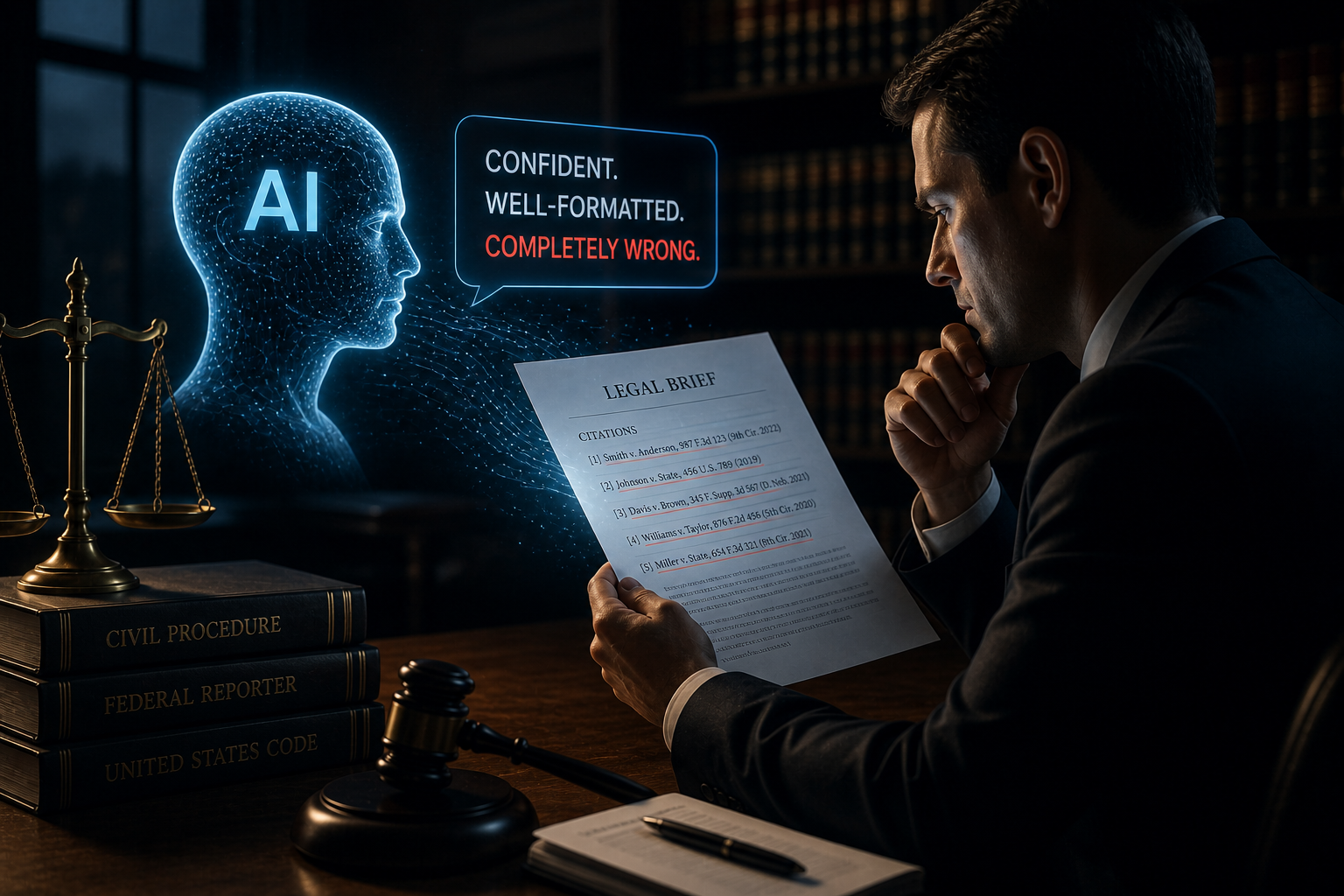
A Nebraska attorney was suspended from practising law. The reason: his AI-generated legal brief contained 20 fabricated citations — including nonexistent cases, fictitious statutes, and court decisions that never happened. The AI produced them confidently, in perfect legal citation format, complete with case names, court designations, and page numbers. Everything except the actual existence of the cases.
Separately: in Q1 2026 alone, U.S. courts imposed over $145,000 in sanctions against attorneys for AI citation errors. And a federal judge ruled that conversations with AI chatbots like Claude are not protected by attorney-client privilege — meaning former CEO Bradley Heppner was ordered to hand over 31 AI-generated documents he had prepared for his legal defence.
AI is a powerful first-draft tool. It is not a final authority. The businesses and professionals who confuse these two things are paying for it — professionally, financially, and legally.
First, Let's Understand What Hallucination Actually Is
The word "hallucination" in AI has a specific technical meaning, and understanding it is important before we talk about how to manage it.
When a large language model (LLM) is asked a question, it generates a response by predicting what text should come next, based on patterns learned from its training data. It doesn't look things up in a database. It doesn't verify facts against a ground truth. It generates plausible text. The problem is that "plausible" and "true" are not the same thing.
When a model generates a confident, fluently-written, perfectly-formatted legal citation for a case that doesn't exist — that's a hallucination. The model has generated text that looks like a legal citation because it has seen millions of legal citations in its training data. The underlying fact (that this case exists) was never verified, because the model has no mechanism to verify it.
This is not a bug that will be patched in the next model update. It is a fundamental characteristic of how current language models work. Even the best models hallucinate. The rate varies — some are better than others — but none are immune, particularly on factual queries about specific real-world entities (cases, statistics, people, papers).
The Specific Problem With Legal Citations
Legal work has a particular vulnerability to AI hallucination:
Citations have a specific format
The model knows exactly what a citation looks like, so hallucinated citations are perfectly formatted — indistinguishable from real ones at a glance.
Case names sound plausible
AI generates case names that follow real naming conventions, making them hard to spot without actually checking each one.
Volume creates false confidence
If an AI generates a 20-page brief with 50 citations, manually checking all 50 feels redundant — but it's not optional.
The consequences of error are severe
Courts don't accept "the AI told me" as an excuse for filing false citations. The professional is accountable.
The Nebraska case is not isolated. It's the visible tip of a large iceberg of professionals using AI-generated content without adequate verification.
The Three Cases That Should Change How You Use AI
Case 1: The Nebraska Attorney Suspension
The attorney filed a legal brief that cited 20 cases — all AI-generated, none real. When opposing counsel challenged the citations, the attorney could not produce the cases because they didn't exist. The state bar subsequently suspended his licence to practise.
The key question is not whether the attorney used AI — using AI to draft legal documents is legitimate and increasingly common. The question is whether he reviewed and verified the AI's output before filing it in court. He did not. This is the fundamental failure: using AI as a final authority rather than a first draft tool.
Case 2: $145,000 in Sanctions in Q1 2026
This number — $145,000 in a single quarter — represents dozens of separate incidents across multiple jurisdictions. The pattern is consistent: attorneys use AI to draft briefs or research memos, AI generates plausible-but-false citations, attorney files without checking, opposing counsel discovers the error, court imposes sanctions.
The legal profession is learning this lesson at scale, at significant cost. Other professions that use AI for high-stakes outputs — medicine, financial advisory, engineering — should watch closely and learn before they have their own version of this wave.
Case 3: AI Conversations Are Not Attorney-Client Privileged
A federal judge ruled that when former CEO Bradley Heppner used AI chatbots to help prepare his legal defence, those conversations did not fall under attorney-client privilege — because AI chatbots are not attorneys and conversations with them cannot be confidential in the same legal sense.
The implication: if you use an AI chatbot to discuss sensitive business or legal matters, those conversations may be discoverable in litigation. Depending on what you said, this could be used against you.
This affects every executive using AI to think through sensitive business situations. It doesn't mean you shouldn't use AI — it means you should understand that these conversations may not be private in the way that conversations with your lawyer are.

AI Hallucination Across Business Functions: Where the Risk Is Highest
Legal is the most visible example right now because lawyers file documents in court — a venue with accountability built in. But the same risk applies across many business functions:
| Business Function | AI Hallucination Risk | Potential Consequence |
|---|---|---|
| Legal briefs and contracts | Very High | Sanctions, malpractice liability, case loss |
| Medical documentation | Very High | Patient harm, regulatory violations, malpractice |
| Financial reports and analysis | High | Investor harm, regulatory penalties, securities fraud |
| Compliance filings | High | Regulatory violations, fines, licence loss |
| Marketing claims | Medium-High | False advertising liability, consumer protection violations |
| HR documentation | Medium | Employment law violations, discrimination claims |
| Customer communications | Medium | Brand damage, customer harm, trust loss |
| Internal research | Lower | Wasted resources, poor decisions based on false data |
The higher the stakes of the decision the AI output is influencing, the more critical human verification becomes.
What Responsible AI Use Actually Looks Like
I want to be constructive here, because the answer is not 'stop using AI.' The answer is 'use AI correctly.' Here's what that looks like in practice.
The First-Draft Rule
AI produces a first draft. Humans review, verify, and finalise. This is not optional for high-stakes work — it is the minimum standard.
For legal documents: every citation must be verified against actual case databases (Westlaw, LexisNexis, Google Scholar). Every statute referenced must be checked against the actual statute. For financial analysis: every number cited from AI output must be traced to a primary source — the company's actual filing, the research firm's actual report. For medical information: clinical details, drug interactions, dosage information, and treatment protocols must be verified against authoritative medical sources.
The Source Verification Workflow
Build this into your process for any AI output that will be used for consequential purposes:
- 1
Generate
Use AI to draft the content — brief, report, document, or analysis.
- 2
Flag
Identify every factual claim, citation, statistic, and reference in the AI output.
- 3
Verify
Check each flagged item against primary sources — actual databases, filings, and authoritative references.
- 4
Correct
Fix or remove anything that cannot be verified against a primary source.
- 5
Review
Have a human expert review the verified final document before it leaves the building.
- 6
Approve
Only then file, send, or publish. The AI output is an input to the process, not the final output.

Using AI Tools With Built-In Verification
Some AI tools are built with retrieval-augmented generation (RAG) — meaning they search actual documents or databases before generating a response, rather than relying purely on training data. Tools like Perplexity, Claude with web search, or legal-specific AI platforms like Harvey or Casetext use verified source retrieval and are significantly less prone to hallucination for factual queries. Know whether the AI tool you're using generates from training data alone or retrieves from verified sources. For high-stakes factual work, prefer retrieval-augmented tools.
Contractual Protections When Using AI Vendors
If your business uses AI tools provided by third-party vendors to produce content that affects clients or customers, your contracts should address:
Liability allocation
Who is liable if AI-generated content causes harm to a client or third party?
Verification standards
What accuracy guarantees does the vendor make, if any?
Indemnification
What protection exists for your business if AI errors cause legal or financial damage?
Data handling
What are the vendor's practices for content you submit — is it used to train future models?
Most current AI vendor agreements don't address these questions adequately. Negotiating them now, before an incident, is far better than discovering the gaps after one.
The Regulatory Direction: Where This Is Heading
Courts are moving faster on AI accountability than legislatures. What we're seeing in 2026 — sanctions for AI errors in legal filings, rulings about AI-generated content and privilege — is the beginning of a judicial framework for AI responsibility.
The direction is clear: professionals cannot disclaim responsibility for AI-generated work product they submit. The 'AI did it' defence is not accepted and will not be accepted. The human professional who used the AI tool is accountable for what that tool produced.
This will eventually generalise beyond law. Expect regulatory guidance in financial services, healthcare, and regulated industries to establish similar accountability standards — that AI-assisted outputs require the same professional verification as human-generated outputs.
Build your AI workflows assuming that full accountability rests with your team, regardless of which tool generated the first draft. Because legally, operationally, and ethically, it does.

The Opportunity in Getting This Right
The businesses that get AI governance right — that build genuine verification workflows, that are transparent about AI use, that maintain clear human accountability — have a significant advantage. As AI hallucination incidents accumulate in the public record, customers and clients are becoming more aware of the risk. A law firm, financial advisor, medical practice, or consulting firm that can demonstrate a rigorous AI review process will differentiate itself from one that simply says 'we use AI' without explaining how.
Trustworthiness is a competitive advantage. Build it now, before your competitors figure out they need to.
At VyaptIX, every AI automation we build includes human review checkpoints for consequential decisions. If you want to discuss how to build AI workflows for your business that are both efficient and appropriately governed, visit vyaptix.com, email ajeet@vyaptix.com, or WhatsApp at +91 97171 56466.